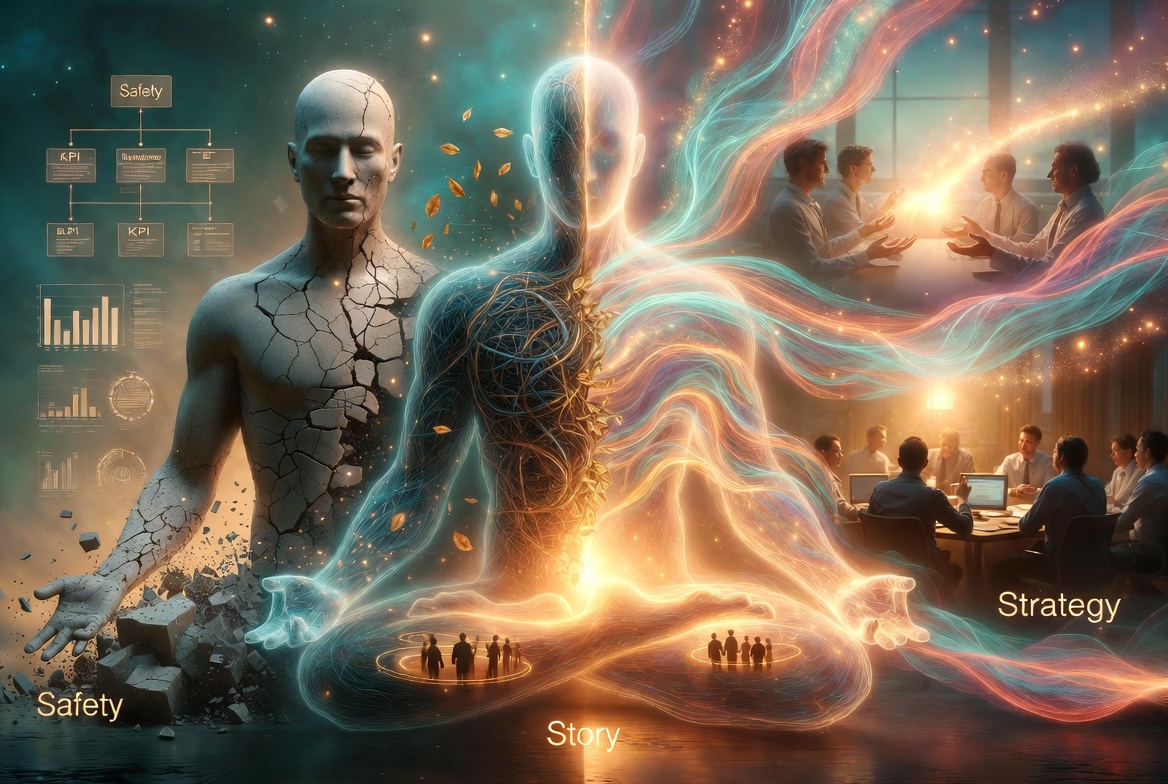
Cracked Statues and Living Stories: A New Path to Organisational Culture Innovation
Contents
Why “culture change” so often fails
Organisations have bodies — not just org charts
Safety: the precondition for honest story
Story: surfacing the narrative that really runs the culture
Strategy: from PowerPoint to embodied practice
The seven movements of SSS-OCI (in plain language)
What if your organisation is actually longing to be re-enchanted?
Why “culture change” so often fails
You know the drill.
A new strategy is launched.
Values are refreshed and printed on posters.
There’s a town hall, a video, maybe even a roadshow.
And then… nothing much changes.
Meetings feel the same. People still don’t say what they really think. The same fires keep burning in thesame corners. Underneath the fresh language, the old culture hums on — untouched.
Why?
Because most culture change only speaks to the head of the organisation (strategy, structures, slogans), and almost never to its body (felt safety, daily interactions, nervous systems) or its story (the deep narrative that quietly runs “how we do things here”).
The SSS-OCI model — Safety, Story, Strategy for Organisational Culture Innovation — is built on a simple conviction:
Unless we work with the body and story of an organisation, strategy will never stick.
Organisations have bodies — not just org charts
We tend to talk about organisations as if they were machines: inputs, outputs, KPIs, operating models.
But anyone who has led or lived in one for long knows that organisations are more like bodies:
·Some teams are constantly in fight-or-flight: rushed, anxious, always behind.
·Others are in shutdown: checked out, cynical, “why bother?”
·A few live in a rare safe-and-engaged space: honest, creative, alive.
This is not just metaphor.
The same nervous system dynamics that shape individual responses to stress also play out collectively: in how people sit in a room, how quickly they speak, whether they dare to disagree, how they recover after a difficult meeting.
Most culture programmes ignore this. They try to change behaviour without first changing physiological state.
The SSS-OCI model refuses to start there. It begins where real change actually lives: in Safety.
Safety: the precondition for honest story
Before an organisation can face its truth, it has to feel safe enough to do so.
Not safe as in “comfortable” or “nice”, but safe enough that:
People can say, “This isn’t working” without punishment.
Leaders can admit, “We contributed to this” without losing face.
The body of the organisation can exhale.
The first movement of SSS-OCI is therefore not a survey or a new initiative, but a reset of the collective nervous system:
Short, regular embodied check-ins to notice: Are we braced, shut down, or actually present?
Leaders learning to regulate themselves in real time, so their bodies signal “we can stay with this” instead of “speed up or shut down”.
Deliberate design of spaces, rhythms, and rituals that tell the body, “You are not under constant threat here.”
Only when this groundwork is laid does the second pillar become possible.
Story: surfacing the narrative that really runs the culture
Every organisation lives inside a story.
There is the official story:
“We are innovative, agile, collaborative, and purpose-driven.”
And then there is thelived story:
“We are exhausted, afraid to fail, and excellent at hiding what’s really going on.”
SSS-OCI treats culture as narrative embodied in practice. The task is not to invent a prettier story, but to name the story that is actually being lived — and then re-author it.
This involves three uncomfortable but liberating moves:
1.Externalise the problem story
Instead of “we are toxic”, we ask:
“What is the story that has taken over here?”
“When did it gain power?”
“What does it make us do when pressure hits?”
2.The organisation is not the problem; the story is.
3.Map the gap between stated and embodied culture
How do we say we make decisions vs how we actually make them?
How do we say we welcome dissent vs what happens to someone who disagrees publicly?
4.Find the cracks in the old story
Even in the most stuck culture, there are sparkling moments:
The project where cross-silo collaboration came alive.
The crisis where someone spoke up and was truly heard.
The day people left a meeting more energised than when they arrived.
5.Those are not accidents. They are seeds of a preferred story.
SSS-OCI makes those seeds visible, honourable, and shareable — so they can grow.
Strategy: from PowerPoint to embodied practice
Once safety has been cultivated and story has been surfaced, most organisations rush back to their comfort zone: strategy documents, pilots, KPIs.
SSS-OCI takes a different path.
The third pillar asks: What would it look like if our strategy was felt in the body, every day?
Instead of defining change only in slides, SSS-OCI invites organisations to:
Prototype new rituals that enact the preferred story in small, repeatable ways.
Treat every meeting, one-on-one, and decision as a practice ground for the new culture.
Check strategy against the felt sense in the room:
Does this path open us up (more energy, curiosity, connection)?
Or does it close us down (tightness, withdrawal, going through the motions)?
In other words:
Strategy stops being “what we say we want” and becomes “how we actually move together.”
The seven movements of SSS-OCI (in plain language)
The full SSS-OCI process moves through seven movements. In blog language:
1.Sense–Notice the body of the organisation.
Where are we anxious? Where are we numb? Where do people come alive?
2.Soften–Drop the armour.
Name the perfectionism, the performance, the “we can’t admit weakness” scripts.
3.Surface–Tell the truth about the current story.
What narrative are we actually living? Who does it serve? Who does it silence?
4.Shift–Re-author the story.
Gather the sparkling moments. Ask, “When were we most ourselves?” Let that story speak.
5.Sustain–Translate story into daily practice.
Create concrete micro-rituals and habits that make the new story real.
6.Shadow–Face what we’d rather project.
Where do we blame individuals for what is systemic? What part of us are we refusing to see?
7.Seed–Anchor all of this in a bigger “why”.
Beyond growth or efficiency: what future are we actually serving? What kind of world does our best work belong to?
This is what makes SSS-OCI more than another change framework. It insists that culture innovation is not only about improvement, but about meaning.
What if your organisation is actually longing to be re-enchanted?
There is a quiet question sitting underneath most burnt-out teams and disillusioned leaders:
“Is this it? Is this all there is to how we work together?”
SSS-OCI takes that question seriously.
It assumes that under the cynicism, under the survival habits, under the endless dashboards and deadlines, there is still a living story trying to come through — one that remembers why the organisation started in the first place, and what kind of good it dreamed of doing.
Culture innovation, in this light, is not a cosmetic upgrade.
It’s a homecoming:
back to bodies that can breathe,
back to stories that can be told without spin,
back to strategies that align with what people actually care about.
If your organisation feels like it is going through the motions, the most important question might not be:
“What’s our new strategy?”
but rather:
“Are we ready to feel, tell, and re-author the story we are actually living?”
Because once you do that with enough safety, honesty, and courage, strategy almost writes itself.