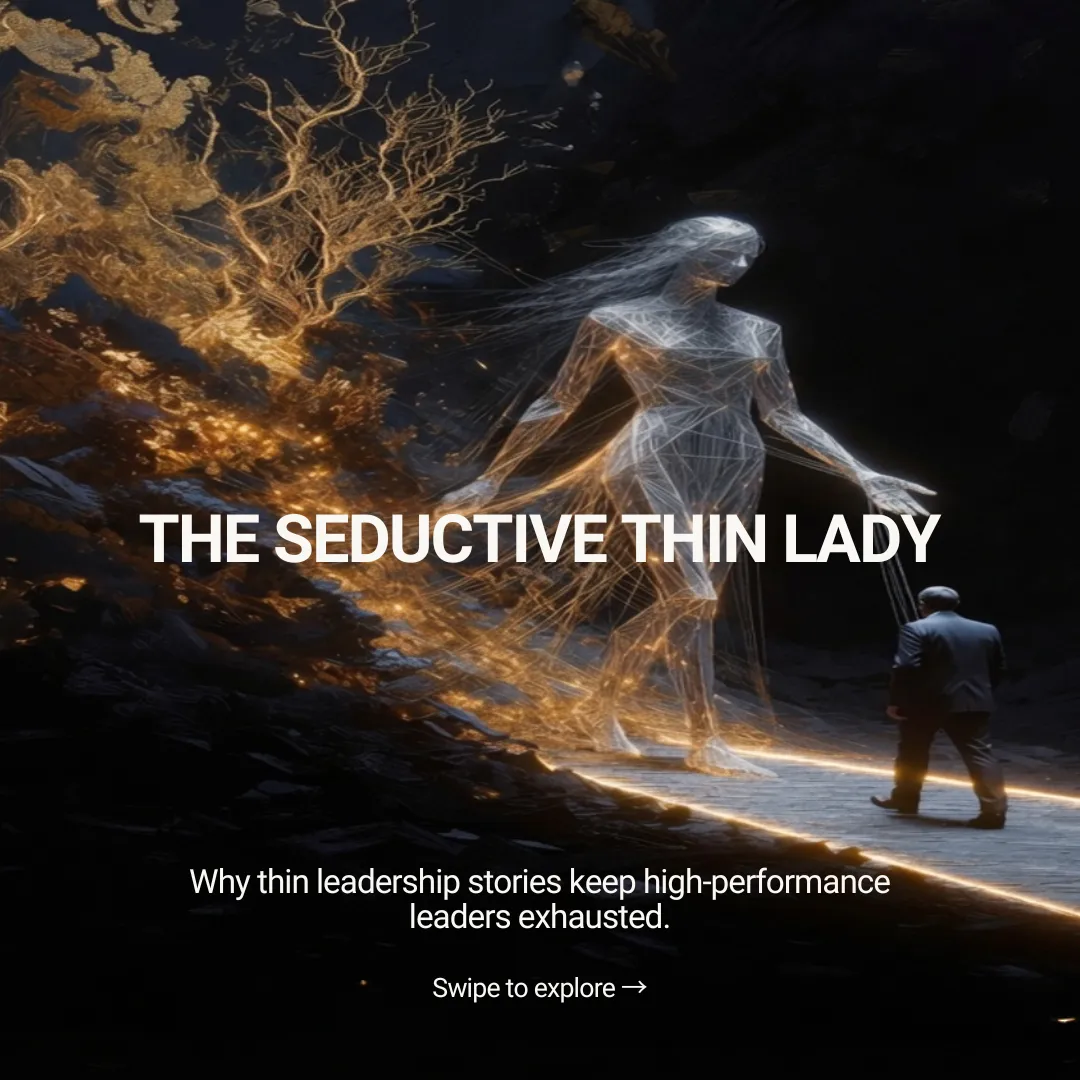
Chapter 2: The Seductive Thin Lady
The Seductive Thin Lady: Why the Stories We Tell Ourselves About Leadership Keep Us Exhausted
The Body Carries What the Mind Agrees To
From Thin to Thick: The First Movements of Freedom
A Small Practice You Can Try Today
The Seductive Thin Lady: Why the Stories We Tell Ourselves About Leadership Keep Us Exhausted
You’re still delivering. Deadlines are met. Your team looks to you for steadiness. Colleagues describe you as reliable, composed, and the one who can carry what others cannot. From the outside, it looks like strength.
Yet inside, something vital is growing thinner.
This is not only about having too much to do. It is about thestoryinside which all that doing is happening. Many leaders reach a point where the pressure no longer feels like a temporary season. It feels like the only realistic way to lead. That shift rarely happens because of one dramatic event. It happens because a particular kind of story has quietly taken over.
I call her the Seductive Thin Lady.
She is not a villain. She is a pattern — the linear, reductive narrative that offers clarity when life feels overwhelming. She takes scattered experiences and arranges them into a straight line:This is just who I am. This is what leadership costs. If I slow down, everything will fall apart. Serious people carry more.
She feels safe because she reduces ambiguity. Under chronic pressure, the nervous system prefers simplicity. Nuance costs energy. Contradiction feels threatening. A clean storyline lowers cognitive load and makes action feel possible — even when that action is slowly depleting the person carrying it.
How Thin Stories Take Root
Thin stories rarely arrive as obvious lies. They recruit real events and real strengths. The leader who has always been the one others can count on receives affirmation for over-functioning. The one who stays calm under pressure earns trust. Over time, a public self becomes highly developed while other parts of the person — curiosity, grief, play, limits, even joy — are granted less and less authority.
What begins as competence slowly becomes identity. Being useful starts to feel like the main proof that you belong. Rest begins to feel morally ambiguous. Even on holiday, the question “Am I using this time well?” can appear uninvited.
Three forces make these stories especially sticky in leadership:
Pressure favours simplicity. When we are already mobilised or partially shut down, complex accounts of ourselves feel expensive. A linear story reduces the load.
Cultures reward coherence. Boards, teams, and stakeholders often experience a neat narrative as more “leadership-like” than honest uncertainty. Ambiguity gets read as weakness.
Identity protection. When self-worth has become tightly linked to performance, any threat to the performance story feels like a threat to the self. The thin story becomes a shield.
Beneath many of these stories sits a quieter, more vulnerable script:not good enough. It rarely speaks in those exact words, but it shapes how success lands (briefly) and how the next inadequacy is already being scanned for. It borrows noble language — service, responsibility, and commitment — until over-functioning starts to look like devotion.
When the Story Becomes Moral
The grip tightens further when consistency itself becomes a virtue. Many of us were formed in families, schools, faith communities, or professions where steadiness, self-sacrifice, and dependability were praised with too little attention to cost. In that atmosphere, loosening the old story can feel like disloyalty — to the people who depended on us, to the earlier version of ourselves who survived by becoming strong and useful, to the culture that still honours heroic endurance.
This is why narrative change is often grief work. The familiar story, even when exhausting, has organised belonging for years. Releasing it can feel less like growth and more like treachery — at least at first.
The Body Carries What the Mind Agrees To
Thin stories do not live only in language. They are stored in posture, breathing, chronic bracing, difficulty settling after achievement, and the quiet inability to experience completion. A leader may intellectually agree that they do not have to prove themselves yet feel their chest tighten the moment they are not immediately useful.
The body often holds the more operational version of the story. It reveals what the system has actually learned about safety, worth, and belonging. This is why purely cognitive insight rarely shifts the pattern on its own. The nervous system must experience enough safety for a different story to become livable.
From Thin to Thick: The First Movements of Freedom
The most liberating shift is often externalisation—separating the person from the problem-saturated story. Instead of “I am an over-functioning leader", the question becomes: “How has the Over-Responsible Story been recruiting me?” Instead of “I cannot slow down", we ask: “What does the Never-Enough Script persuade me to believe about slowing down?”
This small move creates reflective distance. It allows us to examine what the story promises, what it protects, what it costs, and whose voice it carries.
Thicker stories grow through deliberate noticing of what the dominant narrative has edited out: the difficult conversation entered with honesty rather than control, the limit set without catastrophe, the moment of genuine arrival after success, the small act of congruence that did not fit the old line. These micro-moments are not sentimental. They are the first stones in a different foundation.
A Small Practice You Can Try Today
Before your next significant meeting or conversation, pause for ninety seconds:
Take three slow breaths. Notice the sensation of air moving in and out.
Ask: What story am I telling myself right now about this situation, this person, or myself?
Notice any bodily response — tightness, heat, urgency, heaviness, or ease.
Ask one further question: What small part of this moment does not quite fit the story I just told?
This is not a technique for instant transformation. It is a micro-interruption that begins to loosen fusion with the old narrative. Breath creates a little safety. Naming surfaces the story. Curiosity opens space for something thicker.
The Story Is Powerful — But It Is Not Final
The Seductive Thin Lady is persuasive precisely because she organises chaos into something manageable. Yet because she is a story, she can be witnessed, questioned, and gradually re-authored.
The work is not to replace one thin story with another. It is to grow spacious enough for contradiction, tenderness, limits, and aliveness to belong inside the same life as serious leadership.
This is the heart of the Story pillar in the SSS Framework. It prepares the ground for the next movement: Safety — the embodied conditions in which thicker, truer stories can actually be lived rather than merely understood.
If this resonates, I invite you to try the ninety-second practice before your next leadership moment and notice what shifts, however small.
The story beneath the performance is powerful. It is not, however, the only story available.
The Thin Story Check
To help you explore this more personally, I have created the Thin Story Check — a short reflective self-check linked to this week’s theme.
It will not diagnose you. It will not reduce your leadership to a number. Instead, it gives you a personal score and a short educational reading to help you notice how linear, narrow, or open your current leadership story may have become.
Your result will help you reflect on whether you may currently be:
caught in a mostly linear grip,
beginning to thicken the story,
or actively re-authoring the narrative you are living inside.
You can complete the Thin Story Check here.
Once you complete the Check, you will also receive an invitation to join the priority guest list for the upcoming Sculpting Wonder Leadership Conversation series.
If this reflection already feels personally relevant, you are also welcome to book a complimentary conversation with François.
This is a confidential, no-pressure conversation to explore what this may be asking of you in your own leadership context.
You can book a complimentary conversation here.
Sculpting Wonder
Over the coming weeks, the Sculpting Wonder Leadership Conversation series will continue exploring these themes: how thin stories form, why the body often carries what the mind has agreed to, how leadership narratives shape culture, and how the SSS Framework — Safety, Story, Strategy — offers a more sustainable way of leading.
This reflection draws from Week 2 of that journey and from Chapter 2 of my forthcoming book, Sculpting Wonder — a book for high-performance leaders who are still delivering outwardly, but who want to recover the aliveness, presence, meaning, and imagination that make leadership worth inhabiting.
If this conversation matters to you, I invite you to complete the Thin Story Check, receive your personal reading, join the priority guest list, and follow the series as it unfolds.
Looking forward to thinking with you.
Warm regards,
François Wessels