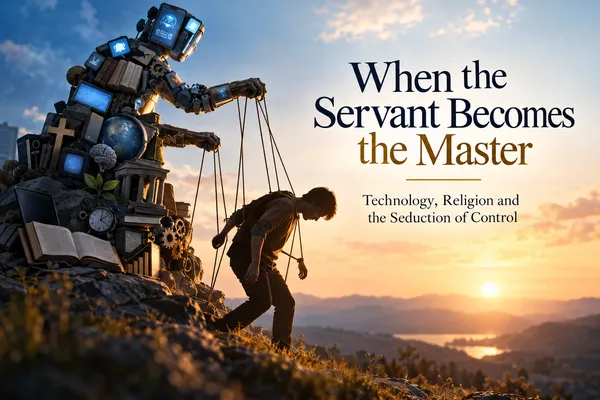
When the Servant Becomes the Master: Technology, Religion and the Seduction of Control.
When the Servant Becomes the Master
Technology, Religion and the Seduction of Control
Human beings are makers of tools. We create things to extend our reach, save time, reduce uncertainty and make life more manageable. The wheel extends movement. Writing extends memory. Medicine extends our ability to intervene in illness. The smartphone extends communication. Artificial intelligence increasingly extends certain forms of thinking, organising and creating.
We also create less obvious technologies. A theory helps us interpret experience. An institution organises collective life. A therapeutic model gives structure to care. A religious tradition preserves stories, practices and wisdom across generations.
Most of these things begin as servants.
And then, sometimes almost imperceptibly, something changes.
The servant becomes the master.
The mobile phone was created so that we could reach one another. Before long, because wecanalways be reached, we begin to assume that weshouldalways be reachable. Email was supposed to make correspondence quicker. Instead, many people now spend hours every day managing the communication system that was meant to save them time. Artificial intelligence promises to accelerate certain kinds of work, but acceleration itself can quickly become the new expectation. If something can now be produced in an hour rather than a day, the organisation may simply begin expecting eight times as much.
The technology does not consciously enslave us. Something more subtle happens. We reorganise life around what the technology makes possible.
Convenience becomes expectation.
Expectation becomes dependence.
Dependence becomes obligation.
And eventually we find ourselves serving the very thing that was created to serve us.
The problem is larger than our devices
It is easy to imagine that this is merely a problem of smartphones, social media or AI. But the dynamic goes much deeper.
A theory can become master.
Theories begin as lenses through which we notice something. Attachment theory may help us recognise relational patterns. Polyvagal theory may help us attend to experiences of safety and threat. Narrative practice may help us notice dominant stories, alternative descriptions and neglected acts of resistance.
But a small shift can occur.
At first we say: “This theory helps me see something.”
Eventually we begin saying: “This theory explains what is happening.”
The map slowly becomes the territory.
Once that happens, we no longer allow the person to interrupt the theory. Instead, we begin fitting the person into our conceptual framework.
Even a therapeutic approach committed to resisting expert interpretation can become a technology. The pastoral practitioner can become so concerned with externalising, re-authoring or asking the “right” narrative questions that the human encounter itself begins to disappear behind the method.
The tool remains useful.
But it is no longer simply a tool.
Perhaps control is the deeper temptation
Why does this reversal happen so easily?
Perhaps because technologies do more than reduce labour. They reduce uncertainty.
Medicine helps us negotiate the uncertainty of the body. Insurance helps us negotiate the uncertainty of the future. Schedules reduce the uncertainty of time. Policies reduce organisational ambiguity. Theories reduce interpretive uncertainty.
Again, none of this is necessarily problematic. Human beings need structures through which to live.
But there is an important difference between a structure that helps us inhabit uncertainty and one that promises to eliminate it.
The first supports life.
The second begins to control life.
A map is useful because it helps me navigate unfamiliar territory. But if I insist that the landscape must conform to the map, I am no longer travelling. I am attempting to discipline reality.
Perhaps much of what we call technological dependence is really the human longing for a world that will stop surprising us.
The caregiver’s version of the same problem
Caregiving is not usually described as a technology, but it too can become governed by technological logic.
People who care for others gradually acquire knowledge and skill. They become reliable. Others begin turning to them in moments of distress. A meaningful identity emerges:
I am the one who helps.
There is beauty in that identity.
There is also danger.
The desire to help can quietly become a sense of responsibility for outcomes.
If the grieving person is still grieving, perhaps I have failed.
If the marriage remains conflicted, perhaps I did not ask the right question.
If the anxious person is still anxious, perhaps I need another intervention.
If someone I love continues making painful choices, perhaps I have not tried hard enough.
Care then begins operating according to technological logic:
If I perform the correct intervention, I should produce the desired result.
But human beings are not machines.
Relationships are not engineering projects.
Healing cannot be manufactured.
Love cannot guarantee an outcome.
Perhaps one of the most important distinctions in mature caregiving is the difference between beingresponsible toanother person and beingresponsible foranother person’s life.
We can offer presence, honesty, skill, compassion and companionship.
We cannot control what ultimately happens.
There is a form of care that becomes possible only when we relinquish the demand to fix.
And then comes the uncomfortable question
Could religion become a technology?
The question may initially sound provocative, perhaps even irreverent. But it deserves attention.
Religion is certainly more than technology. It encompasses story, belonging, ritual, community, moral imagination, encounter, devotion and mystery.
Yet religion can beused technologically.
Technological logic says:
If I perform X correctly, Y should follow.
Religious life can quietly acquire exactly this structure.
If I pray correctly, God should answer.
If I believe the correct doctrines, uncertainty should disappear.
If I behave properly, God should bless me.
If I follow the right spiritual disciplines, I should become peaceful.
If I give sufficiently, blessing should follow.
If I possess the correct theology, I will know exactly what God is doing.
Faith then becomes a mechanism.
Prayer becomes technique.
Scripture becomes an instruction manual.
Doctrine becomes certainty management.
Spirituality becomes self-improvement.
And God becomes predictable.
Religion has become a technology for producing spiritual outcomes.
The management of mystery
Perhaps the deeper temptation of religion is therefore not unbelief, but themanagement of mystery.
Many religious traditions begin with encounter.
Someone experiences liberation.
Someone hears a call.
A community encounters grace.
A prophet is interrupted.
A disciple recognises something astonishing.
The experience is narrated. The story is remembered. Practices grow around it. Ritual preserves it. Communities form. Institutions develop.
All of this is necessary.
Without containers, memory disappears.
But then something strange can happen.
The structure created to preserve the encounter can eventually become more important than the encounter itself.
Encounter becomes story.
Story becomes tradition.
Tradition becomes practice.
Practice becomes institution.
Institution becomes preservation.
At the beginning stands mystery.
At the end can stand administration.
One can imagine Moses standing before the burning bush: surprised, interrupted, unable to control what is happening.
A few generations later, one can almost imagine a Committee for the Regulation of Burning Bushes.
Where may bushes burn?
Who is authorised to approach them?
Which forms of fire are legitimate?
What language may be used to describe them?
Eventually the institution may become remarkably efficient at preserving the memory of burning bushes while leaving almost no space for anything actually to burn.
The exaggeration is humorous because the danger is recognisable.
We protect the container.
And sometimes forget what the container was created to hold.
Religion as certainty-producing machinery
The temptation becomes particularly strong because religion lives close to some of the deepest uncertainties of human existence.
Who am I?
Why am I here?
What happens when I die?
Why do people suffer?
Am I loved?
Does my life matter?
Is there a God?
Religious narratives help us inhabit these questions. But helping us inhabit mystery is very different from promising to abolish mystery.
Faith can become a possession of answers rather than a relationship of trust.
There is a profound difference between saying:
“I possess a framework that explains reality.”
and saying:
“I entrust myself to a Reality that exceeds my framework.”
The first easily becomes mastery.
The second requires humility.
This may help explain why Jesus so frequently resists religious certainty. When asked about the Kingdom of God, he does not normally provide definitions. He tells stories.
The Kingdom is like seed.
Yeast.
Treasure.
A pearl.
A father waiting.
Workers in a vineyard.
Bridesmaids in the dark.
These images do not close reality down.
They open it.
A technical manual gives instructions. A parable destabilises perception.
A formula says: “Here is how it works.”
A parable whispers: “Look again.”
Technology and sacrament
Perhaps we can make an important distinction here.
Technology says:
If I perform X correctly, I can produce Y.
Sacramental imagination says:
I make myself available to something I cannot produce.
This does not mean passivity. Preparation matters. Discipline matters. Practice matters.
But practice creates availability, not control.
Consider contemplation.
Contemplation can itself become another technology. We meditate for twenty minutes to reduce stress. We practise mindfulness to improve productivity. We breathe slowly so that we can return more efficiently to work.
There may be nothing wrong with these outcomes.
But they are not the whole of contemplation.
At its deepest, contemplation may be one of the few spaces in contemporary life in which nothing needs to be produced.
I do not have to optimise myself.
I do not have to reach an outcome.
I do not have to solve anything.
I become available.
Available to myself.
Available to another.
Available to grief.
Available to beauty.
Available to silence.
Available to God.
Available to surprise.
And this makes contemplation quietly subversive in a technological culture.
It restores the possibility of uselessness.
It rehabilitates waiting.
It allows reality to be more than what I can make of it.
Healthy systems remain interruptible
Perhaps this gives us a practical criterion for all the tools and structures we create.
A healthy tool remainsinterruptible by the reality it exists to serve.
A school must remain interruptible by the learner.
A medical system by the patient.
A therapeutic theory by the person’s actual experience.
A church by the people at its margins.
A doctrine by mystery.
A pastoral method by the person sitting across from us.
An AI system by human judgement.
A story by something that does not fit the story.
Interruption reminds the system that it is not ultimate.
The servant remains a servant because it can still be told:
Not now.
Not here.
Not like this.
This person is more complicated than your categories.
Wonder may be one of our forms of resistance
There is another practice that resists mastery: wonder.
Wonder occurs when reality exceeds our expectations.
It says:
There is more here than I thought.
That sentence is profoundly disruptive to the technological imagination.
Control wants predictability.
Wonder receives surprise.
Control wants closure.
Wonder remains open.
Control asks what something is useful for.
Wonder sometimes allows it simply to be.
Perhaps wonder therefore performs an important theological and ethical function.
The person before me is more than my diagnosis.
The world is more than my theory.
The patient is more than the disease.
The stranger is more than the category into which I have placed them.
The Bible is more than an answer book.
God is more than my theology.
And I am more than the systems through which I have learned to interpret myself.
Wonder keeps the world open.
Putting the tools down
The answer is not to reject technology.
Nor is it to abandon institutions, theories, therapeutic methods or religious traditions.
The challenge is to return them to their proper scale.
Tools are valuable.
But they are still tools.
Maps are necessary.
But they are not the territory.
Containers matter.
But they are not the mystery they hold.
Perhaps wisdom therefore includes the capacity occasionally to put our tools down.
Turn off the phone.
Leave the question unanswered.
Allow a conversation to remain unresolved.
Sit beside someone without trying to fix them.
Read Scripture without immediately extracting a principle.
Enter silence without demanding an experience.
Pray without prescribing the answer.
Stand before beauty without photographing it.
Allow grief to remain grief.
Allow mystery to remain mystery.
These may appear to be small gestures.
In a culture organised around productivity, prediction and control, they may actually be acts of resistance.
The great danger of the technological age may not finally be that machines become more like human beings.
It may be that human beings increasingly imagine themselves as machines.
Inputs and outputs.
Problems and solutions.
Efficiency and optimisation.
Prediction and control.
When that logic enters religion, faith becomes a form of spiritual engineering.
There is another possibility.
Faith as participation rather than mastery.
Care as presence rather than control.
Contemplation as availability rather than productivity.
Religion as a tradition capable of being interrupted by the Mystery it exists to serve.
Perhaps a healthy church is one still capable of being surprised by God.
A healthy theology remains interruptible by encounter.
A healthy doctrine remains interruptible by love.
A healthy pastoral practice remains interruptible by the person.
And a healthy life remains interruptible by wonder.
The servant becomes the master not because we use tools.
It happens when we forget that they are tools.
Perhaps wisdom begins in remembering.
And sometimes in putting them down.