Stop Pushing Strategy
Why Real Team Transformation Begins with Safety
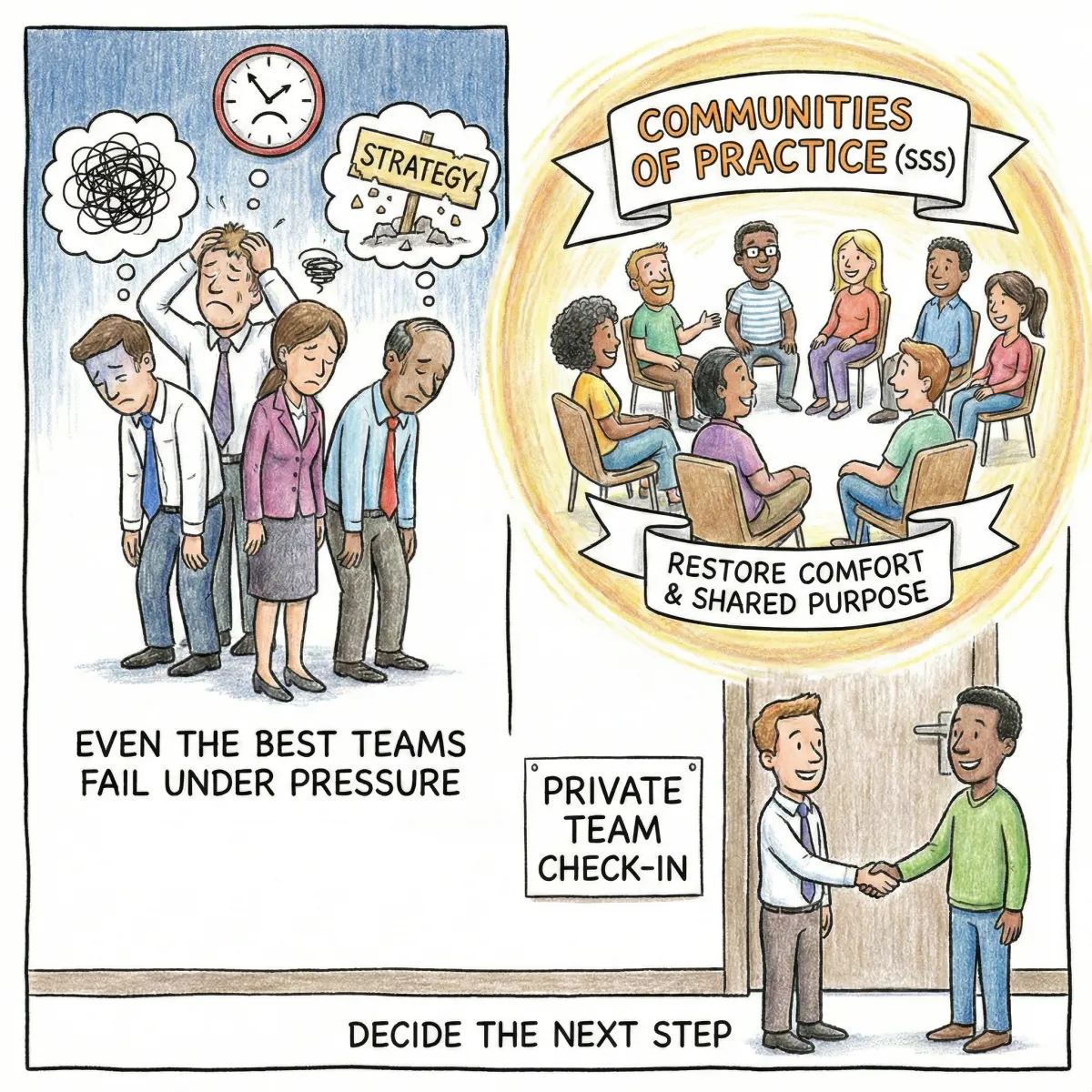
Your team is talented and well-intentioned. Yet, something is fundamentally off. Communication breaks down under pressure, decision-making feels sluggish, and innovation has stalled. Despite wellness programs and team-building exercises, burnout is spreading, and performance has plateaued. You’ve tried new frameworks and clearer goals, but the core issues persist.
This is a common and frustrating scenario for leaders who see the potential in their people but can't seem to unlock it. The reason traditional fixes fail is that they attempt to solve a strategic problem when the root cause is biological. Most approaches miss the foundational element upon which all success is built because they focus on the what and the how without first addressing the team's physiological state.
Lasting transformation isn't about pushing strategy harder or crafting a more inspiring mission statement in a vacuum. It requires addressing three interconnected dimensions in a very specific order: Safety, Story, and Strategy. The most profound shift a team can make is to stop focusing on the top of the pyramid and start building from the bottom up.
1. Most Organizations Are Inverted: They Lead with Strategy Instead of Safety
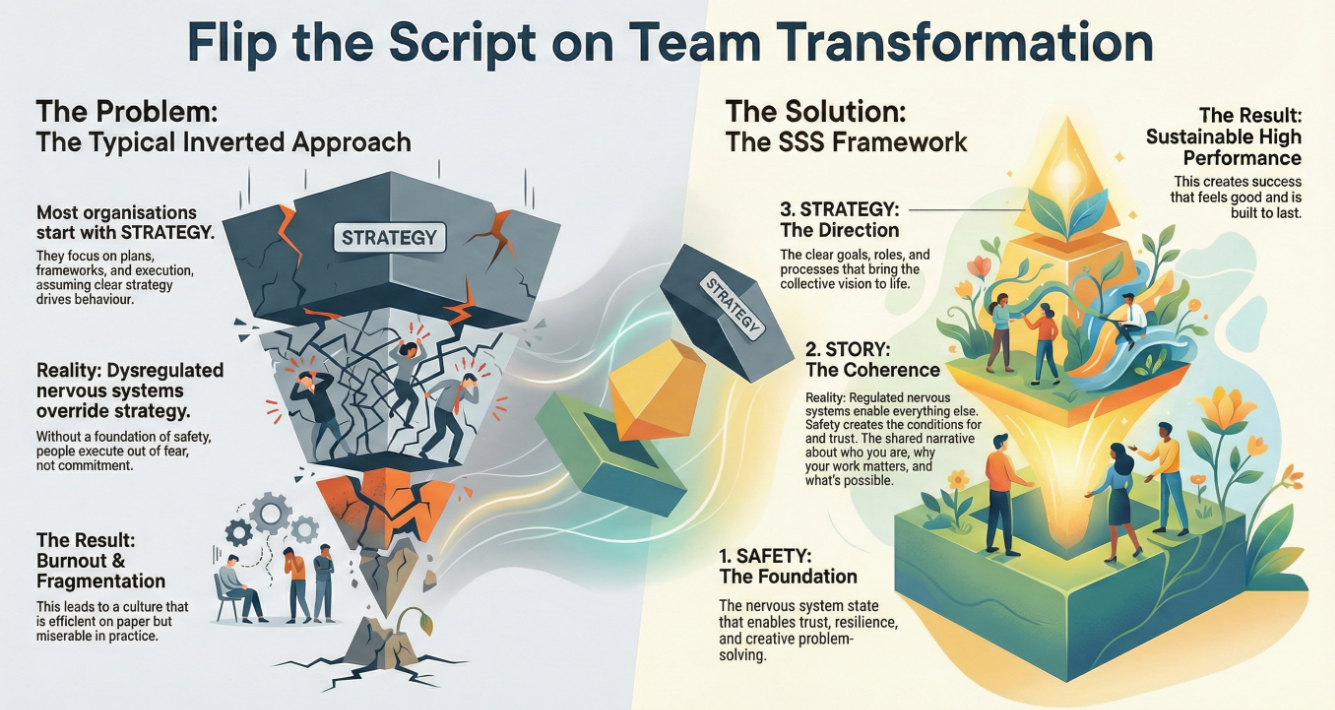
The core, counter-intuitive argument of the SSS Approach is that most organisations mistakenly prioritise Strategy—plans, frameworks, goals, and execution—above all else. They might add a layer of Story through culture initiatives, but Safety is almost never addressed as the primary building block. This inverted approach is the root cause of many persistent team dysfunctions.
When strategy is pushed onto a team that lacks a foundation of safety and a coherent narrative, the results are predictable and draining: "Execution without buy-in; burnout despite goal achievement; fragmentation despite success." Leaders assume a clear strategy will drive behaviour, but in reality, a dysregulated nervous system will always override it. The outcome is an organisation that is efficient on paper, miserable in practice. The SSS Approach flips this model, starting with nervous system safety to create the necessary conditions for genuine collaboration, adaptation, and performance that's also sustainable.
"As a leader, I was driving strategy hard without understanding that my own dysregulation (lack of Safety) was preventing authentic collaboration and narrative alignment. Learning SSS transformed how I lead. I'm not pushing strategy harder; I'm building Safety first, which makes everything else possible." — Chief of Operations, Healthcare
2. Safety Is a Physical Reality, Not Just a Psychological Idea
When the SSS framework talks about "Safety," it’s referring to something more fundamental than an abstract concept. It is a tangible, physiological state rooted in the team's collective nervous system. At any given moment, a team's nervous system is either detecting safety or threat, and this biological reality dictates what is possible.
When a team's collective nervous system detects safety, it enters a "Safe & Social" state that unlocks the capacity for creative problem-solving, genuine trust, and resilience. In contrast, when it detects threat—through harshness, unpredictability, or invalidation—it shifts into a survival state of fight/flight or shutdown. This response severely limits cognitive and relational capacity, making high-level collaboration impossible. This foundation cannot be achieved through intellectual exercises; it must be built somatically through tangible leadership behaviours like regulated presence, consistent attunement, and embodied reliability.
You cannot think your way into safety. You cannot strategise your way into trust.
3. An Aligned Story Gives Purpose, But It Must Be Grounded in Safety
Once a foundation of safety is established, the next layer is "Story." In this context, a Story is the shared narrative that gives a team coherence and purpose. It’s the collective answer to the questions: Who are we? What are we committed to? Why does our work matter?
The link between Story and Safety is critical. Attempting to tell stories of growth and possibility while team members are in a physiological state of threat creates internal fragmentation. The team is forced to navigate the chasm between the "official story" of the mission statement and their felt, "operative story" of unsafety. This disconnect feels inauthentic, erodes trust, and is why so many culture decks fail to inspire real change. Conversely, when Safety is present, a team can honestly examine its operative stories, release limiting narratives, and co-author a new one that aligns with its true values and vision.
4. True Strategy Becomes an Expression of a Coherent Team, Not an External Constraint
Strategy is the final and emergent layer, effective only when the foundational layers of Safety and Story are aligned. Strategy includes essential operational elements such as clear goals and metrics, decision-making frameworks, defined roles, and resource allocation. But its effectiveness is entirely dependent on the state of the team executing it.
In the absence of the other two elements, strategy becomes dysfunctional:
Strategy without Safety becomes oppressive, as people execute tasks out of fear rather than genuine commitment.
Strategy without Story becomes meaningless, as goals feel disconnected from a larger purpose, leading to disengagement.
When Safety and Story are solid, however, Strategy transforms. It becomes a vehicle for collective vision rather than an external constraint. Execution is no longer a source of dread but is carried out with presence, creativity, and shared commitment, leading to success that feels good to the people living it.
"Our innovation pipeline was stuck because people didn't feel safe (Safety), didn't understand why we were doing this work (Story), and were confused about direction (Strategy). SSS gave us a framework to address all three in the right order. Everything shifted." — Director of R&D, Manufacturing
Conclusion: A Final Thought
The chronic issues that plague talented teams—burnout, stalled innovation, and poor communication—are rarely the result of a bad strategy. They are symptoms of an inverted approach to performance that ignores the biological foundation of human collaboration. By prioritising plans over presence, we create environments that are efficient on paper but unsustainable for the people within them.
The most profound shift a leader can make is to invert this traditional model. By building a foundation of nervous system Safety first, teams create the fertile ground where an authentic Story can emerge, and an effective Strategy can be executed with energy and purpose. This is how you achieve not just high performance, but sustainable performance.
What would become possible if your team stopped asking, 'What's our strategy?' and started asking, 'Have we created the physiological safety required to build one together?'