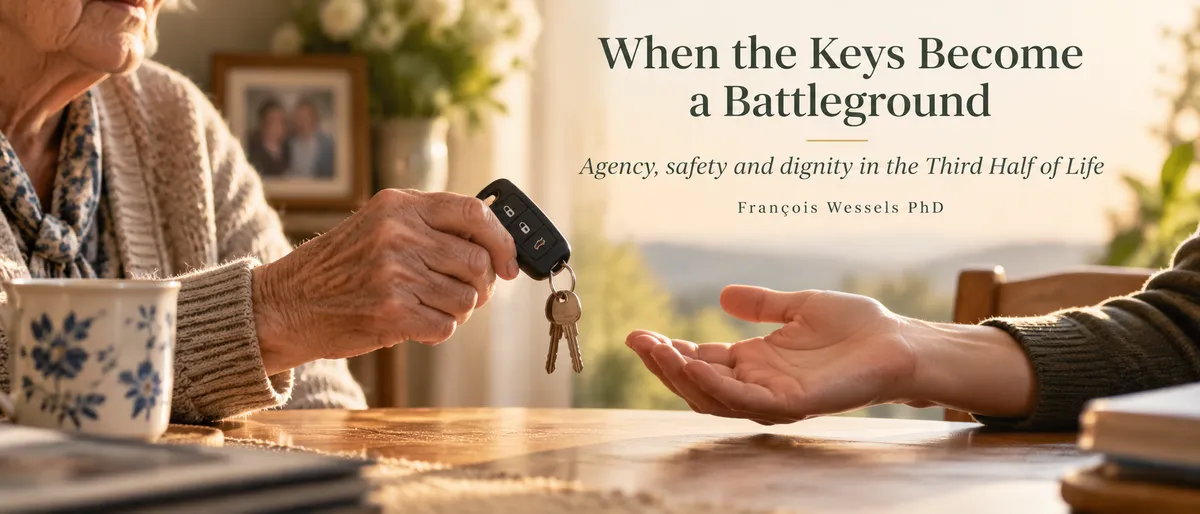
When the Keys Become the Battleground
It Was Never About the Car
There is a moment many families will recognise. The keys have quietly migrated from the hook by the front door to the bottom of a daughter's handbag. A licence renewal letter sits unanswered on the kitchen table. And the conversation everyone has been dreading finally happens —"Dad, we think it's time to stop driving"— and it goes badly. There is anger, obstruction, sometimes real aggression. The family is bewildered. They were only trying to help. They love him. Why is he fighting them so hard over something so obviously sensible?
The answer is that the conversation they think they're having is not the conversation he's having. They are talking about road safety. He is hearing something else entirely:You are no longer competent. You cannot be trusted. Other people control your life now.
Because in later life, driving is almost never only about transport.
What a car actually carries
A car can stand for far more than the ability to get from one place to another. It can mean autonomy, competence, usefulness, privacy, adulthood itself. For someone who spent sixty years providing for a family, the ability to drive may quietly hold an entire identity:I am the one who gets us where we need to go.For a person who has already lost a spouse, a career, physical strength and half their friends, the car may be one of the very last visible symbols that they are still an independent adult in charge of their own life.
Take that away abruptly, and you are not removing an inconvenience. You are, in the person's own experience, confirming that the end has begun. The apparently disproportionate anger suddenly makes sense. Very often, it is grief wearing armour.
The cycle nobody chose
What makes these conversations so painful is that everyone means well and everyone still ends up trapped. It tends to run like this:
The family notices unsafe driving and becomes anxious. Anxiety makes them directive —we've decided, give me the keys.Being managed threatens the older person's sense of control, so they push back to prove they're still capable. The pushback frightens the family, who tighten their grip further. Round it goes.
The single most useful thing you can do is to name this loop out loud, because it moves the problem out of the "difficult old man" and into a cycle that is hurting everyone caught inside it. The real question stops being"How do we keep him safe?"and becomes something more humane:How do we increase safety without unnecessarily stripping away his dignity?
The idea that changes everything: autonomy is not independence
If there is one distinction worth holding on to, it is this one.
Independence means I can do everything myself. Autonomy means I still have meaningful say over my own life.
Independence does narrow as we age — that is simply true, and pretending otherwise helps no one. But autonomy need not shrink at the same rate. A person may genuinely no longer be safe behind the wheel andstilldecide where they want to go, when, who they'd prefer to take them, which outings matter most, and which alternatives they're willing to accept.
The moment you grasp this, the whole conversation shifts. The problem quietly changes fromdriving— which has exactly one solution, and it's a loss — tomobility, which has many."You can't drive anymore"becomes"If driving is getting risky, how do we make sure you still have as much freedom to get around as possible?"
From "No" to "How?"
Families instinctively reach for the language of prohibition. You can't drive to church. You can't go to the shops on your own.Every sentence is a door closing.
A small change in wording opens them again. How can we make sure you still get to church whenever you want? How can shopping stay something you're in charge of?It sounds almost too simple, but it moves a family from restriction into problem-solving — and it invites the older person to help design the answer rather than merely submit to it.
That participation matters more than almost anything else. An abrupt confiscation feels like being overruled. A transition the person helped to plan feels like a decision they were part of, even when the destination is the same.
Watch the slippery slope
There's a particular trap for loving families. Once one capacity is lost, it's tempting to generalise.Because Dad can't drive, maybe we should take over his banking. Maybe he shouldn't cook. Maybe we should decide where he lives.Older people sense this drift very quickly — and often resist thefirststep so fiercely precisely because they can feel thelastone coming.
Two questions help enormously here, asked together, out loud:What genuinely needs to change?And, just as importantly,What does not need to change?Protecting the domains that don't need protecting is not sentimentality. It is one of the most therapeutic things a family can do.
Compassion and boundaries can coexist
None of this means tolerating abuse. Understanding why someone is angry is not the same as accepting being frightened or insulted, and families — especially those trapped in guilt, telling themselveshe's old, we just have to put up with it— need permission to say so. Both things can be true at once:"I understand why losing control over your life makes you angry. And we still need to find ways to talk about it that don't hurt the people trying to help."That is neither punitive nor patronising. It's honest.
The question underneath it all
Here is the principle I keep coming back to, and it reaches far beyond driving:
Behaviour that looks like resistance is very often an attempt to protect a threatened self.
Ask"What is this behaviour trying to protect?"instead of"How do we get him to comply?", and you stop managing a difficult old man. You start accompanying a person through a genuine loss — and helping his family do the same.
Which is why, if a family takes only one sentence away from all of this, I would want it to be the question they most need to learn to ask:
"How can we care for you without making you feel we've taken your life away from you?"